
Statutory Damages Vs. Actual Damages In Privacy Litigation
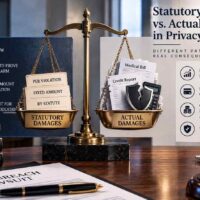
If a company collects your personal information without permission, exposes your sensitive data, misuses your biometrics, or violates your privacy rights, you might wonder how much your claim could be worth. The answer often depends on whether the law allows for statutory damages, actual damages, or both. These two types of compensation work differently and can greatly affect your case. Statutory damages are especially helpful when it is hard to put a dollar value on the harm caused by a privacy violation. Actual damages, on the other hand, are based on losses you can prove, like stolen money, costs from identity theft, lost income, or other financial harm. At Net Law Advocates, we help clients across the United States with cybersecurity, privacy, biometric, data breach, and identity theft cases. We look at every possible way to get compensation based on the laws that apply to your situation.
What Are Statutory Damages In A Privacy Case?
Statutory damages are set amounts of money that the law allows for certain violations. Instead of having to prove exactly how much money you lost, the law may let you recover a fixed amount or use a formula if you meet its requirements.
This matters because privacy violations do not always lead to an immediate bill or clear financial loss. For example, if someone’s fingerprint or facial scan is collected without permission, their privacy rights are violated even if no money is taken from their account right away.
Whether you can get statutory damages depends on the specific law involved. There is no single federal privacy law that guarantees a set payment for every privacy or cybersecurity violation. We review which federal and state laws might apply, whether they let you sue, what you need to prove, and what types of compensation they allow.
Illinois Biometric Privacy Claims Provide An Important Example
The Illinois Biometric Information Privacy Act, or BIPA, is a good example of why it is important to understand the difference between statutory (or liquidated) damages and actual damages.
Under 740 ILCS 14/20, an aggrieved person may bring an action against an offending party. The statute provides for liquidated damages of $1,000 or actual damages, whichever is greater, for a negligent violation. An intentional or reckless violation can support liquidated damages of $5,000 or actual damages, whichever is greater. The statute also permits reasonable attorneys’ fees and costs and other appropriate relief.
BIPA is especially important for employees and consumers whose fingerprints, hand scans, facial scans, or other biometric data may have been collected, stored, shared, or used in ways that break the law.is important when calculating potential recovery. Under the current version of Section 20, repeated collection of the same person’s biometric information through the same collection method constitutes a single violation of Section 15(b) for purposes of recovery.
Similarly, repeated disclosure of the same biometric information to the same recipient using the same method constitutes a single Section 15(d) violation for recovery purposes.
That distinction matters when evaluating a claim. A damages analysis should be based on the statute as it currently exists rather than simply multiplying every scan or transaction by a statutory amount.
What Are Actual Damages?
Actual damages generally concern losses the plaintiff can establish resulted from the wrongful conduct. In a cybersecurity or privacy case, those losses can vary substantially depending on what information was compromised and what happened afterward.
A data breach victim, for example, might experience unauthorized withdrawals, fraudulent credit accounts, identity theft, lost wages while addressing the problem, or expenses incurred attempting to restore financial accounts. A business victim of cyber-related misconduct may have different provable financial losses.
Evidence becomes particularly important when actual damages are claimed. We may examine financial records, fraudulent transactions, correspondence, credit information, invoices, employment records, and other documentation capable of establishing both the loss and its relationship to the alleged violation.
A privacy violation does not automatically establish every category of actual damages a plaintiff seeks. Causation, standing, the governing statute, available remedies, and the evidence supporting the claimed loss can all become disputed issues.
Federal Privacy Law Can Provide Different Damage Remedies
Federal law demonstrates why privacy claims must be evaluated statute by statute. The federal Wiretap Act, part of the Electronic Communications Privacy Act framework, provides a civil remedy under 18 U.S.C. § 2520 for certain unlawful interception, disclosure, or intentional use of wire, oral, or electronic communications.
For many actions covered by Section 2520©(2), a court may assess the greater of actual damages plus profits made by the violator or statutory damages calculated at $100 per day of violation or $10,000, whichever statutory measure is greater. The statute also identifies other potential relief, including punitive damages in appropriate cases and reasonable attorneys’ fees and litigation costs.
That does not mean every improper use of digital information qualifies for damages under the federal Wiretap Act. The facts must satisfy the statutory requirements. We examine the technology involved, what was allegedly intercepted or disclosed, consent issues, the defendant’s conduct, and other statutory elements before determining whether a federal claim may apply.
Why Statutory Damages Can Matter When Financial Loss Is Difficult To Prove
Privacy rights would provide limited protection if every victim had to wait until stolen information produced measurable financial fraud before seeking relief. Some statutes address that problem by providing monetary remedies tied to violations themselves, subject to their particular requirements.
Consider a worker whose covered biometric identifier was collected in violation of an applicable biometric privacy statute. The employee might not have experienced an unauthorized withdrawal or damaged credit score. That does not necessarily mean the alleged privacy violation is legally meaningless.
Statutory or liquidated damages can therefore play an important role in cases involving intangible privacy interests. Whether they are actually recoverable, and in what amount, depends on the governing law and facts.
Actual Damages Can Become Significant After Identity Theft
A different situation arises when exposed information is actually exploited. Suppose a cybersecurity incident exposes a person’s Social Security number, date of birth, financial information, or account credentials and criminals subsequently use that information.
The victim may discover unauthorized accounts, fraudulent transactions, tax fraud, or other forms of identity theft. Those circumstances can create documented losses that may become part of an actual-damages analysis where the governing cause of action permits them.
One of the central legal issues may be causation. A defendant may dispute whether a particular breach caused the later fraud. We therefore look closely at the chronology, type of information compromised, timing of fraudulent activity, other known exposures, and available evidence connecting the alleged misconduct to the claimed injury.
Privacy Litigation May Involve More Than One Form Of Relief
Damages are only one component of a privacy lawsuit. Depending on the statute and circumstances, plaintiffs may also seek injunctive or equitable relief, attorneys’ fees, litigation costs, punitive damages, restitution, or other remedies authorized by law.
The available remedies can also differ substantially among states. A claim involving biometric information in Illinois may operate under a very different statutory framework from a data breach claim arising elsewhere. Federal statutes can add another layer when electronic communications, unauthorized access, consumer records, or other federally regulated conduct is involved.
For that reason, we do not treat every privacy incident as the same type of lawsuit. We determine where the affected person lives, where the defendant operated, what information was involved, how it was obtained or exposed, what happened to it, and which laws potentially govern the conduct.
Class Actions And Large Groups Of Privacy Victims
Statutory damages can become particularly important when the same practice affects a large number of people. An employer might use the same allegedly unlawful biometric system for hundreds or thousands of employees. A business might suffer a cybersecurity incident exposing information belonging to a substantial number of customers.
Depending on the facts and applicable law, claims may be pursued individually or through class litigation. The existence of statutory damages does not mean that every affected person automatically receives a particular payment or that class certification is automatic. Courts must address standing, statutory elements, class certification requirements, defenses, damages, and other legal questions.
Our cybersecurity lawyers evaluate both the individual harm and the broader conduct involved. The objective is to identify the claims and remedies supported by the evidence rather than assume that the same damages theory applies to every victim.
Why The Difference Between Statutory And Actual Damages Matters
The distinction can determine whether a viable privacy case exists even when immediate financial losses appear small. Statutory remedies can recognize certain legally protected interests without requiring plaintiffs to calculate every injury in dollars. Actual damages can address documented financial or other legally compensable consequences when those losses can be established.
Some statutes permit the greater of statutory or actual damages. Others establish different remedies, requirements, or limitations. Some privacy laws do not provide consumers with a private lawsuit for damages at all.
This is why we evaluate the precise statute before estimating what compensation may be available. Privacy litigation is highly dependent on the type of information involved, the conduct alleged, the jurisdiction, and the evidence of harm.
Contact Our National Cybersecurity Lawyers About A Privacy Claim
If a company unlawfully collected your biometric information, exposed your personal data, violated your digital privacy, or failed to protect information that was later used for identity theft or fraud, you may have legal rights even when your immediate financial losses are difficult to calculate. Our cybersecurity lawyers represent plaintiffs in Cyber Law, Biometric Privacy, Data Breach Litigation, and Identity Theft matters throughout the United States. We evaluate the laws that apply to the incident, the evidence of harm, and whether statutory damages, actual damages, or other relief may be available.
Please fill out our secure web form or call our firm at 888-913-2318 for your free consultation. We represent individuals, employees, consumers, and other plaintiffs nationwide and can review the circumstances surrounding the alleged privacy or cybersecurity violation. The amount and type of compensation available depend on the applicable law and facts of each case.
