
What Is Facial Recognition Bias?
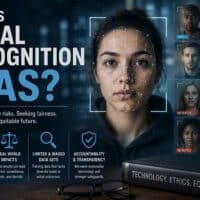
Facial recognition technology works by analyzing a person’s facial features and comparing them to stored images or biometric data. More and more businesses use this technology for things like security, verifying identities, controlling access, preventing fraud, managing employees, and monitoring customers. Issues can occur if the system gives inaccurate results, treats certain groups unfairly, collects biometric data without permission, or fails to keep sensitive facial data secure. A false match can lead to someone being wrongly accused, denied services, watched more closely, facing job issues, or suffering other serious harm. Collecting facial biometric data also raises privacy concerns because these identifiers are not the same as regular account information. At Net Law Advocates, we help people across the United States whose privacy, biometric data, or personal information has been misused or compromised.
What Does Facial Recognition Bias Mean?
Facial recognition bias means the technology does not work equally well for everyone. It may be more or less accurate for people of different races, ethnicities, ages, genders, or other groups.
The National Institute of Standards and Technology (NIST) has tested many facial recognition algorithms. Their research found that most algorithms perform differently for different demographic groups, though the results can vary a lot between systems. NIST also points out that not all facial recognition systems work the same way.
One particularly important problem is a false positive. This occurs when facial recognition technology incorrectly determines that photographs of two different people depict the same person. A false negative occurs when the technology fails to match images that actually depict the same individual.
The consequences depend heavily on how the technology is being used. Failing to unlock a device because of a false negative may be inconvenient. Being falsely identified as a suspected shoplifter, fraudster, or unauthorized person can have much more serious consequences.
Why Can Facial Recognition Produce Biased Results?
Facial recognition systems depend on algorithms, image quality, databases, system configuration, matching thresholds, and other technical factors. Differences in any of these areas can affect accuracy.
Training and development data can also matter. A system developed or tested using data that does not adequately reflect the population on which it will eventually be used may perform differently across demographic groups. Poor-quality surveillance photographs, lighting, camera angles, aging, image resolution, and the composition of the comparison database can further affect performance.
NIST has reported substantial differences among facial recognition algorithms and has found that image quality can contribute to demographic effects. This is one reason a company should not assume that purchasing facial recognition software means the technology will perform accurately in every environment or for every person.
Facial Recognition Bias Can Cause Real-World Harm
The legal concern is not simply that an algorithm makes a mathematical error. The greater concern is what happens to a person after that error.
Consider a retailer that uses facial recognition cameras to compare shoppers against a database of people suspected of previous theft. An incorrect match could cause an innocent customer to be followed by security personnel, questioned, searched, removed from the store, publicly accused, or reported to law enforcement.
This is not merely hypothetical. In a Federal Trade Commission action involving Rite Aid’s former use of facial recognition technology, the FTC alleged that false-positive matches resulted in consumers being followed, searched, removed from stores, confronted by police, or publicly accused of wrongdoing. The FTC also alleged that the company’s practices disproportionately affected people of color.
For plaintiffs, these consequences matter. A facial recognition error may result in financial losses, reputational damage, emotional distress, loss of opportunities, invasion of privacy, or other legally recognized injuries depending on the circumstances and applicable law.
Facial Recognition Also Creates Biometric Privacy Concerns
Accuracy and bias are only part of the legal picture. Before facial recognition software can analyze a face, information about that person’s facial characteristics may be captured, processed, converted into a mathematical representation, or compared against other information.
That raises an important question: Did the company have the legal right to collect or use the biometric information in the first place?
State biometric privacy laws can impose requirements concerning notice, consent, disclosure, retention, destruction, and protection of biometric information. The exact rights available depend heavily on the jurisdiction and circumstances.
Illinois provides one prominent example. The Illinois Biometric Information Privacy Act, commonly called BIPA, addresses biometric identifiers and biometric information. Its statutory definition of a biometric identifier includes a scan of face geometry, while photographs themselves are excluded from that definition.
This distinction can become important in facial recognition litigation. The legal analysis may concern what information the technology derived from an image, how that information was collected, whether consent was obtained, how long the data was retained, and whether it was disclosed or transferred to another entity.
What Happens When Facial Recognition Data Is Breached?
Facial recognition systems can create another significant concern: cybersecurity.
Passwords can be changed. Credit card numbers can be replaced. A person’s face cannot.
When a business creates or maintains biometric templates, facial geometry information, or databases containing other sensitive identifiers, a cybersecurity incident may expose information that cannot simply be reissued.
A breach involving facial recognition information may therefore raise several separate issues. We may examine why the organization collected the data, what information it actually maintained, how it protected that information, whether unauthorized parties accessed it, whether third-party vendors received it, and whether affected individuals received legally required notifications.
The existence of facial recognition bias does not automatically establish a data breach claim, and a data breach does not necessarily mean facial recognition bias occurred. But the issues can intersect when a company collects biometric information through a facial recognition system, uses that system in ways that harm individuals, and then fails to adequately protect the resulting data.
Who May Have A Facial Recognition Claim?
Potential plaintiffs can include consumers, employees, job applicants, tenants, patients, students, travelers, and others subjected to facial recognition technology.
A potential claim could arise when a person is falsely identified and suffers harm. Another case could involve facial biometric information collected without legally required notice or consent. A different claim could result from the disclosure or breach of stored biometric information.
Because privacy and biometric laws differ significantly from state to state, there is no single nationwide rule governing every facial recognition case. The applicable law can depend on where the individual lives, where the information was collected, what the organization did with it, what disclosures were provided, and what harm resulted.
Our cybersecurity lawyers examine those facts to determine what rights and remedies may be available.
Why Facial Recognition Cases Require Careful Investigation
A company may describe its system as accurate without explaining how it performs under the actual conditions in which it is being used. A meaningful investigation may require examining the technology involved, the quality and source of the images, the comparison database, accuracy testing, false-positive rates, company procedures, employee training, vendor relationships, and safeguards designed to prevent incorrect decisions.
NIST’s research demonstrates why those details matter. Its testing has found that accuracy and demographic differentials can vary considerably among algorithms. In earlier large-scale testing, NIST found that false-positive rates in some one-to-one algorithms were substantially higher for Asian and African American faces than for Caucasian faces, while performance varied across developers and some algorithms demonstrated much smaller differentials.
The important question in a lawsuit is not simply whether facial recognition technology can be biased. We must determine what happened to the particular plaintiffs, what technology was used, whether legal obligations were violated, and what damages resulted.
Protecting The Rights Of People Harmed By Facial Recognition Technology
Companies adopting facial recognition technology should not be permitted to transfer the risks of inaccurate or unlawful systems to consumers and employees. When a business chooses to collect sensitive biometric information, we believe it must take its legal responsibilities seriously.
At Net Law Advocates, we represent plaintiffs in matters involving biometric privacy, cybersecurity, data breaches, identity theft, and related digital rights violations. We investigate how personal information was collected, how technology was used, what protections were in place, and whether corporate conduct violated applicable law.
If facial recognition technology falsely identified you, your facial biometric information was collected or used without proper authorization, or your biometric data was exposed in a security incident, there may be legal options available.
Contact Net Law Advocates About A Facial Recognition Or Biometric Privacy Claim
Facial recognition technology can affect much more than digital privacy when it is used improperly. An incorrect match can lead to accusations, financial consequences, loss of opportunities, or serious damage to a person’s reputation. Unauthorized collection or insecure storage of facial biometric information can create separate privacy and cybersecurity concerns.
At Net Law Advocates, our cybersecurity lawyers represent plaintiffs throughout the United States in biometric privacy, data breach, identity theft, and Cyber Law matters. We work to hold businesses accountable when unlawful data practices or technology failures cause harm.
If you believe facial recognition technology falsely identified you, your facial biometric information was collected or used unlawfully, or your biometric data was exposed in a security incident, please fill out our secure web form or call our firm at 888-913-2318 for your free consultation. We represent clients throughout the United States and can review the circumstances to determine what legal options may be available.
