
Why Repeated Data Breaches Strengthen Plaintiff Lawsuits
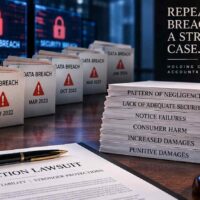
A data breach can put Social Security numbers, financial details, medical records, login information, employee files, and other sensitive data at risk. If the same company is breached again, the legal issues can become much more serious. A previous cybersecurity incident may have already alerted the company to problems in its security and the risks of not fixing them. For plaintiffs, this history can be key evidence about whether the company was warned, if the risk was foreseeable, if security was reasonable, and if the later breach could have been avoided. At Net Law Advocates, we help consumers, employees, patients, businesses, and others across the United States who have suffered financial or privacy harm after cybersecurity incidents. We look at what happened in the most recent breach, what the organization knew beforehand, and how it responded.
Why A Previous Data Breach Can Matter In A Lawsuit
A plaintiff usually cannot prove liability just because a company was hacked more than once. Even companies with strong security can be targeted by cybercriminals, so having multiple breaches does not automatically mean the company was negligent.
History matters when a previous incident showed a weakness, security problem, or risk that the company did not fix. A past breach can warn a company that its systems, procedures, employee training, authentication, vendor controls, or response plans need improvement.
Imagine a company has a breach that exposes employee information. An investigation finds weak access controls and suggests new safeguards. Two years later, attackers use similar weaknesses to steal employee data again. In a lawsuit about the second breach, we would look at whether the company made the recommended changes, tested them, monitored its systems, and acted on what it learned from the first breach.
That history can provide a very different factual setting from a company encountering a genuinely unforeseen threat for the first time.
Repeated Breaches May Strengthen Evidence Of Foreseeability
Foreseeability can be important in negligence claims arising from cybersecurity failures. Plaintiffs may need to establish that the type of harm they suffered was reasonably foreseeable and that the defendant failed to exercise the level of care required under applicable law.
A previous attack can potentially provide evidence that a company knew sensitive information was vulnerable. Prior ransomware attacks, phishing incidents, credential compromises, unauthorized database access, or security assessments may have identified risks before the breach that ultimately harmed the plaintiff.
Courts still examine duty, causation, injury, and other requirements under the governing state law. A prior incident does not eliminate those requirements. Instead, it may become evidence supporting an allegation that another intrusion and resulting disclosure were foreseeable.
What Did The Company Do After The First Breach?
One of the questions we may investigate in a repeat-breach case is straightforward: What changed after the first incident?
A company that discovers cybersecurity deficiencies may have opportunities to improve access controls, strengthen authentication, encrypt sensitive information, patch vulnerable systems, revise data-retention practices, improve employee training, supervise vendors, and enhance intrusion detection.
The answer cannot always be found in the public breach notification. Litigation may uncover internal security assessments, forensic reports, remediation plans, communications, audit findings, vendor records, and other evidence concerning the company’s response.
Evidence that a business identified a serious vulnerability but allegedly left it unresolved may be significant. So may evidence that management received warnings about cybersecurity problems and failed to respond appropriately.
State Data Security Laws Can Affect Plaintiff Claims
There is no single federal statute governing every private-sector data breach lawsuit. The applicable legal framework can depend on the plaintiff’s state, the defendant, the information involved, the industry, and the particular conduct alleged.
California provides an important example. California Civil Code § 1798.150 provides a limited private right of action when specified nonencrypted and nonredacted personal information is subject to unauthorized access and exfiltration, theft, or disclosure because of a business’s failure to maintain reasonable security procedures and practices appropriate to the nature of the information. Depending on the circumstances, qualifying consumers may seek actual damages or statutory damages of $100 to $750 per consumer per incident. Not every privacy violation qualifies for this private action, so the facts and statutory requirements must be evaluated carefully.
Other states impose security duties that can become relevant to litigation even when their statutes do not create the same private remedy. Illinois’ Personal Information Protection Act, 815 ILCS 530/45, for example, requires covered data collectors to implement and maintain reasonable security measures protecting records containing Illinois residents’ personal information. Courts applying Illinois law have recognized that the 2017 amendment adding this language changed the statutory landscape concerning a data collector’s security duty.
New York’s SHIELD Act, N.Y. General Business Law § 899-bb, similarly requires covered persons and businesses possessing New York residents’ private information to develop, implement, and maintain reasonable safeguards. Those safeguards concern administrative, technical, and physical security.
These differences are one reason nationwide breach litigation requires a state-by-state legal analysis.
A Company’s Remediation History Can Become Important Evidence
Repeated incidents may raise questions extending beyond the existence of two breach notifications. We may examine whether the company performed a meaningful investigation after the earlier incident and whether it followed recommendations made by cybersecurity professionals.
Relevant issues can include whether the company:
- corrected known software or network vulnerabilities;
- implemented appropriate multifactor authentication and access controls;
- adequately trained employees concerning phishing and social engineering;
- encrypted or otherwise protected sensitive information;
- evaluated third-party vendors with access to protected data; and
- updated its cybersecurity program as new threats or weaknesses became known.
The New York SHIELD Act illustrates why ongoing security practices matter. Its framework identifies measures such as assessing foreseeable internal and external risks, evaluating safeguards, training employees, selecting service providers capable of maintaining appropriate protections, and adjusting security programs as circumstances change.
Repeated breaches may therefore allow plaintiffs to compare what an organization said it would correct with what it actually did.
Previous Breach Notices And Public Statements May Matter
Companies frequently make statements after cybersecurity incidents describing what happened and what they intend to do about it. They may tell customers that security has been enhanced, systems have been reviewed, additional monitoring has been implemented, or remedial measures have been taken.
Those representations can become relevant when another incident occurs.
Our cybersecurity lawyers may compare earlier notices, regulatory filings, privacy policies, public statements, and subsequent breach disclosures. If the second incident appears connected to previously identified weaknesses, the company’s earlier representations may warrant closer examination.
The question is not simply whether the company promised that another breach would never occur. No organization can guarantee that. The more useful question is whether its actual security practices reasonably addressed known risks.
Repeated Incidents Can Affect Causation And Damages Arguments
Plaintiffs must still establish legally recognized injury and connect that harm to the incident at issue. That requirement can be particularly important when an individual has had information involved in several unrelated breaches.
A repeat breach at the same company can nevertheless provide important evidence about causation when the exposed information, timing, subsequent fraud, and security failures can be connected. We may examine breach timelines, identity-theft events, unauthorized financial activity, credit reports, fraudulent accounts, phishing activity, and other evidence.
Potential damages depend heavily on applicable law and individual circumstances. They may include unreimbursed financial losses, costs incurred responding to identity theft, lost time, certain consequential damages, and statutory damages when authorized. Plaintiffs should not assume that receiving complimentary credit monitoring represents full compensation for legally recoverable harm.
Employees Can Be Victims Of Repeated Corporate Data Breaches
Employees provide employers with extraordinarily sensitive information. Payroll and human-resources systems may contain Social Security numbers, addresses, dates of birth, bank account information, tax documents, health information, driver’s license information, and information concerning family members.
When an employer experiences repeated cybersecurity incidents, affected workers may have serious questions about whether their information was reasonably protected.
We represent plaintiffs rather than employers defending breach claims. When employees come to us following a corporate breach, we examine the information exposed, previous cybersecurity incidents, applicable state laws, the employer’s security practices, and any evidence of actual misuse or financial loss.
A worker should not assume that an employer’s status as another victim of a cyberattack necessarily resolves the legal issue. Criminal hackers may have committed the intrusion, but litigation may separately examine whether the organization entrusted with the information took legally adequate measures to protect it.
Repeated Data Breaches Do Not Automatically Establish Liability
It is important to distinguish strong evidence from automatic liability. A company can experience more than one sophisticated cyberattack despite taking reasonable precautions. Two incidents may also be entirely unrelated.
For that reason, we investigate the details rather than relying solely on the number of breaches.
The strength of a plaintiff’s case may depend on what the defendant knew, the security measures in place, the similarity between incidents, the information exposed, applicable statutes, whether warnings went unaddressed, and whether the plaintiff suffered legally cognizable harm.
For plaintiffs, the central issue is often whether the latest breach was simply another attack or whether it reflects a preventable failure to correct cybersecurity problems the organization already knew existed.
Speak With Our National Cybersecurity Lawyers About A Repeated Data Breach Claim
If a company has suffered multiple data breaches and your personal, financial, employment, medical, biometric, or other sensitive information was exposed, the company’s cybersecurity history deserves careful examination. A previous incident may have provided warnings about vulnerabilities, security practices, or risks that should have been addressed before another breach occurred. Our cybersecurity lawyers represent plaintiffs throughout the United States and investigate whether companies failed to take reasonable steps after learning that sensitive information was at risk.
Net Law Advocates represents consumers, employees, businesses, and other victims seeking accountability for cybersecurity failures, privacy violations, data breaches, identity theft, and related digital harms. We examine prior incidents, security practices, breach notifications, remediation efforts, applicable state and federal requirements, and the losses suffered by our clients.
If your information was compromised in a data breach, particularly when the company has experienced previous security incidents, you may have legal options. Do not assume that another breach is simply unavoidable or that complimentary credit monitoring addresses every form of harm you have suffered.
Please fill out our secure web form or call our firm at 888-913-2318 for your free consultation. We represent plaintiffs throughout the United States and can evaluate the circumstances surrounding the breach, the company’s prior cybersecurity history, and the laws that may apply to your claim.
